

Link to original article HERE
I've always believed that if some exercise is good, more must be better.
Train harder. Lift more. Run farther. Push yourself.
As a hybrid athlete, that's the mindset I've lived by for years. But a recent study made me stop and think.
Researchers followed nearly 150,000 adults for about 30 years to see how different amounts of exercise affected longevity. The results were interesting because they challenged the idea that piling on more and more training automatically leads to a longer, healthier life.
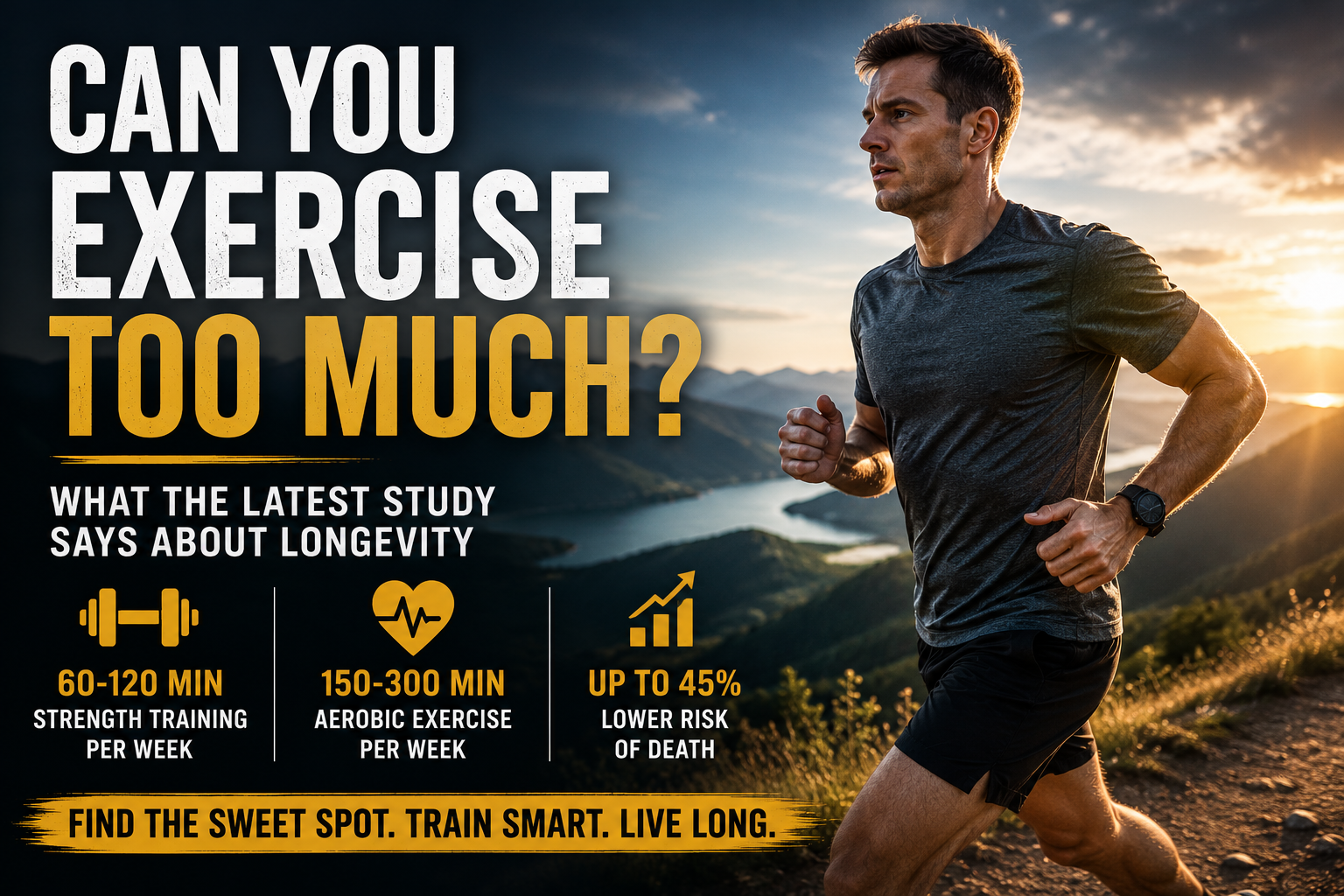
The study found that the greatest reduction in the risk of death came from combining regular strength training with aerobic exercise, but not in extreme amounts.
The sweet spot looked something like this:
Around 150 to 300 minutes of moderate aerobic exercise each week.
Roughly 60 to 120 minutes of strength training each week.
Participants who stayed in those ranges experienced the greatest longevity benefits. In other words, exercising consistently mattered more than trying to be the person who never misses a workout and always does more.
I'll admit something.
I may be guilty of overdoing it.
I genuinely love training. Lifting weights, running, hiking, mountain biking, skiing, bodysurfing—being active is part of who I am. Exercise has transformed my life physically, mentally, and spiritually. It helped me become a better father, a better pilot, a better coach, and simply a healthier person.
But there's a difference between training for performance and training for longevity.
Elite athletes accept greater wear and tear because they're chasing a specific goal. Most of us aren't preparing for the Olympics or trying to win a world championship. We're trying to stay healthy enough to enjoy life, play with our grandchildren, travel, hike mountains, and remain independent well into our later years.
That's an important distinction.
Exercise is one of the most powerful medicines we have. It lowers the risk of heart disease, diabetes, certain cancers, depression, cognitive decline, and countless other conditions. It improves strength, mobility, confidence, and quality of life.
But like many good things, more isn't always better.
Recovery isn't a sign of weakness. It's part of the training process.
Your muscles grow during recovery. Your joints recover during recovery. Your nervous system resets during recovery. Without enough recovery, the very thing that's supposed to make you healthier can eventually begin working against you.
That doesn't mean you should stop challenging yourself.
Lift weights.
Do your cardio.
Go for the hike.
Ride the bike.
Take the swim.
Play the sport you love.
Just remember that the goal isn't to win every workout. The goal is to be healthy enough to keep showing up for decades.
This study didn't convince me to stop training hard.
It reminded me to train wisely.
Because the healthiest body isn't the one that's simply capable of doing the most today.
It's the one that's still strong, capable, and enjoying life thirty years from now.